ASN-to-BSN

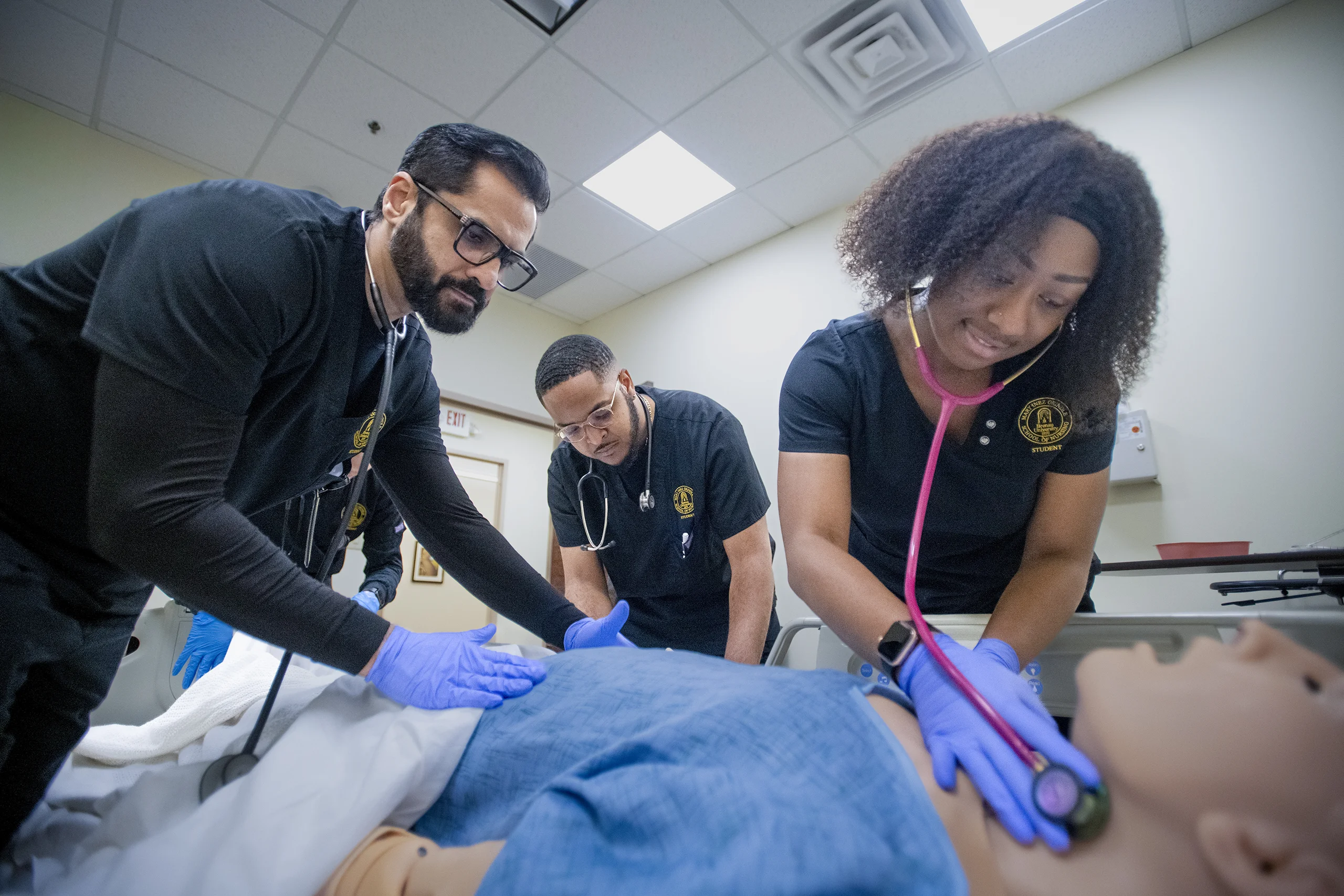
Nursing students practice on a simulation mannequin

Overview

Advance your nursing career with a flexible ASN-to-BSN program designed for licensed registered nurses who want to build leadership skills, strengthen clinical judgment, and expand their impact across patients, communities and healthcare systems.

Guided by the American Association of Colleges of Nursing (AACN) essentials, Brenau’s ASN-to-BSN curriculum builds on the knowledge and experience you already bring as a practicing RN. Rather than repeating foundational nursing content, the program focuses on baccalaureate-level practice in evidence-based care, population health, leadership, informatics, ethics, and systems thinking.

Program Detail Description
Duration (Semesters) 3 semesters full-time or 4 semesters part-time
Credit Hours Required 45-48 total credit hours, depending on prerequisites satisfied
Modality Online
Degree Type Bachelor’s of Science in Nursing (BSN)
Tuition $375/credit hour

Why choose Brenau’s ASN-to-BSN program?

  • Designed specifically for working registered nurses
  • Fully online coursework with flexible full-time and part-time pathways, so you can continue to work while you advance your career
  • Builds on prior nursing education and clinical experience
  • Emphasizes leadership, evidence-based practice, population health, informatics, and quality improvement
  • Includes community-based clinical and capstone experiences that connect coursework to real practice settings
  • Supports preparation for expanded professional responsibility in today’s rapidly changing healthcare environment

What you’ll learn

The curriculum is organized around core content areas that support advancement to baccalaureate nursing practice:

  • Enhanced nursing science for clinical judgment
  • Evidence-based practice and scholarship
  • Leadership, management and professionalism
  • Population health and community/public health nursing
  • Systems, finance, and healthcare delivery models
  • Informatics and technology
  • Quality and safety science
  • Interprofessional collaboration
  • Liberal education and professional identity

Student opportunities

  • Strengthen clinical judgment for complex patient and population needs
  • Apply evidence to practice and quality improvement efforts
  • Expand your understanding of community and population health
  • Develop leadership and policy awareness for professional nursing roles
  • Build informatics and healthcare technology competencies
  • Complete a leadership-focused capstone experience that synthesizes BSN-level learning

To be able to practice professionally after completion of this program, you must pass a professional certification exam.

Upon completion of the BSN and Direct Entry MSN program requirements, you will be eligible to take the NCLEX (National Council Licensure Examination) required for practice as a professional registered nurse.

Additional program details

Outcomes

Upon completion of the ASN-to-BSN program, graduates will be able to:

  1. Provide compassionate, culturally responsive, evidence-based person-centered care
  2. Strengthen clinical judgment by integrating nursing knowledge, evidence, and systems thinking
  3. Apply population health principles to improve outcomes for individuals, families and communities
  4. Translate evidence into practice through inquiry, appraisal and quality improvement
  5. Apply quality improvement and safety science to reduce risk and improve outcomes
  6. Use informatics and healthcare technologies to support decision-making and care delivery
  7. Collaborate effectively with interprofessional teams
  8. Demonstrate systems thinking and leadership in healthcare delivery and advocacy
  9. Demonstrate professionalism, ethical comportment, and accountability in nursing practice
  10. Commit to lifelong learning, reflective practice, resilience, and ongoing professional growth

Career and professional advancement

An ASN-to-BSN degree can support professional advancement in areas such as:

  • leadership and charge nurse roles
  • community and public health settings
  • care coordination
  • quality improvement
  • case management
  • informatics-related roles
  • preparation for graduate nursing education

Coursework overview

NG301R – Conceptual Basis of Professional Nursing

Explores professional identity, accountability, nursing theory, ethics, communication, and the evolving role of the BSN-prepared nurse.

NG304R – Comprehensive Health Assessment

Builds advanced assessment and clinical judgment skills for complex patients and populations.

NG320R – Applied Pathophysiology

Emphasizes application of pathophysiologic principles to evidence-informed nursing decisions, quality, safety, and systems-based care.

NG407R – Community Based Nursing Practice

Focuses on population health, health promotion, disease prevention, and community-based clinical practice.

NG309R – Evidence-Based Practice

Introduces research appraisal, inquiry, and evidence translation to support practice improvement.

NG405R – Leadership & Policy in Professional Nursing

Examines leadership, advocacy, policy, and the nurse’s role in influencing health outcomes.

NG420R – Nursing and Healthcare Informatics

Develops skills in health information technology, data use, clinical systems, and informatics-supported care.

NG430R – Issues & Ethics in Nursing Practice

Analyzes ethical, legal, professional, and systems-level issues affecting contemporary nursing practice.

NG445R – Professional Nursing Practice RN-BSN Capstone

Provides a culminating leadership-focused practicum and capstone project that synthesizes learning across the program.

Sample plans of study

Full-time

Semester 1

  • SH101 Spanish Language & Culture I
  • NG301R Conceptual Basis of Professional Nursing
  • NG304R Comprehensive Health Assessment
  • NG320R Applied Pathophysiology
  • MS205 Introduction to Statistics

Semester 2

  • SH102 Spanish Language & Culture II
  • NG407R Community Based Nursing Practice
  • NG309R Evidence-Based Practice
  • Literature or fine art liberal education course
  • NG405R Leadership & Policy in Professional Nursing

Semester 3

  • NG430R Issues & Ethics in Nursing Practice
  • NG445R Professional Nursing Practice RN-BSN Capstone
  • NG420R Nursing and Healthcare Informatics
  • History liberal education course

Part-time

Semester 1

  • NG301R Conceptual Basis of Professional Nursing
  • NG304R Comprehensive Health Assessment
  • NG320R Applied Pathophysiology
  • MS205 Introduction to Statistics

Semester 2

  • SH101 Spanish Language & Culture I
  • NG407R Community Based Nursing Practice
  • NG309R Evidence-Based Practice
  • Literature or fine art liberal education course

Semester 3

  • SH102 Spanish Language & Culture II
  • NG420R Nursing and Healthcare Informatics
  • NG430R Issues & Ethics in Nursing Practice

Semester 4

  • NG405R Leadership & Policy in Professional Nursing
  • NG445R Professional Nursing Practice RN-BSN Capstone
  • History liberal education course

Note: Some liberal education requirements may be met through transfer credit.

Clinical/community experiences must be completed in person, separate from your employment and be supervised by Brenau faculty.

Admissions requirements

To be considered for admission to the ASN-to-BSN program, applicants must meet the following requirements:

Required academic background

  • Graduation from an accredited Associate Degree in Nursing (ADN) or Associate of Science in Nursing (ASN) program
  • Current, unencumbered registered nurse (RN) license in a U.S. state or territory, with eligibility for licensure in Georgia.
  • Minimum cumulative GPA of 2.5 on a 4.0 scale
  • Official transcripts from all postsecondary institutions attended

Prerequisite coursework

Student must have completed the following courses:

  • EH 101 Written Communication
  • EH 102 Reading & Research Writing
  • MS 101 College Algebra, MS 111 Pre-Calculus/Trigonometry, or MS 210 Calculus and Analytical Geometry
  • PY 101 Introduction to Psychology
  • BY 206 Microbiology and BY 206L Microbiology Lab
  • BY 209 Human Anatomy & Physiology I and BY 209L Human Anatomy & Physiology I Lab
  • BY 210 Human Anatomy & Physiology II and BY 210L Human Anatomy & Physiology II Lab

Additional admissions requirements

  • Good academic and professional standing at the most recently attended nursing program
  • Criminal background check and drug screening, as required by clinical agencies
  • Compliance with health, immunization, and CPR requirements before clinical or practice experiences
  • Access to reliable internet and a personal computer that meets program requirements

Academic Partnership Pathways

Through an articulation agreement with the Technical College System of Georgia, we are able to accept all credits from your Associate of Nursing degree from any of the following schools.

  • Albany Technical College
  • Athens Technical College
  • Atlanta Technical College
  • Augusta Technical College
  • Central Georgia Technical College
  • Chattahoochee Technical College
  • Coastal Pines Technical College
  • Columbus Technical College
  • Georgia Northwestern Technical College
  • Georgia Piedmont Technical College
  • Gwinnett Technical College
  • Lanier Technical College
  • North Georgia Technical College
  • Oconee Fall Line Technical College
  • Ogeechee Technical College
  • Savannah Technical College
  • South Georgia Technical College
  • Southeastern Technical College
  • Southern Crescent Technical College
  • Southern Regional Technical College
  • West Georgia Technical College
  • Wiregrass Georgia Technical College
Read our Press Release about the Agreement

FAQs

ASN-to-BSN, Bachelor's Degrees

What is Brenau’s ASN-to-BSN program?

It is a BSN completion program for licensed RNs who want to advance to baccalaureate-level nursing practice.

ASN-to-BSN, Bachelor's Degrees

Is the ASN-to-BSN program online?

Coursework is online, but clinical or community-based applied experiences are completed in person.

ASN-to-BSN, Bachelor's Degrees

How long does the ASN-to-BSN program take?

Students may complete the program in 3 semesters full-time or 4 semesters part-time, depending on transfer credit and course planning.

ASN-to-BSN, Bachelor's Degrees

Who is eligible to apply?

Applicants should hold an ADN or ASN, have an active unencumbered RN license, meet prerequisite requirements, and meet the minimum GPA and admission standards.

ASN-to-BSN, Bachelor's Degrees

How many total credits are required for the degree?

The BSN requires 120 total semester hours, including challenge credit, transfer/prerequisite coursework, and Brenau coursework.

ASN-to-BSN, Bachelor's Degrees

How much Brenau coursework is required?

Thirty credit-hours must be completed at Brenau.

Related Programs

  • Ivester College of Health Sciences, Nursing

    Accelerated Bachelor of Science in Nursing

    Undergraduate / BSN
  • Ivester College of Health Sciences, Nursing

    Bachelor of Science in Nursing

    Undergraduate / BSN
  • Ivester College of Health Sciences, Nursing

    Master of Science in Nursing – Direct Entry

    Graduate / MSN